How Vendors Can Win Reverse Auctions on VendorBidz (A Practical Seller's Guide)
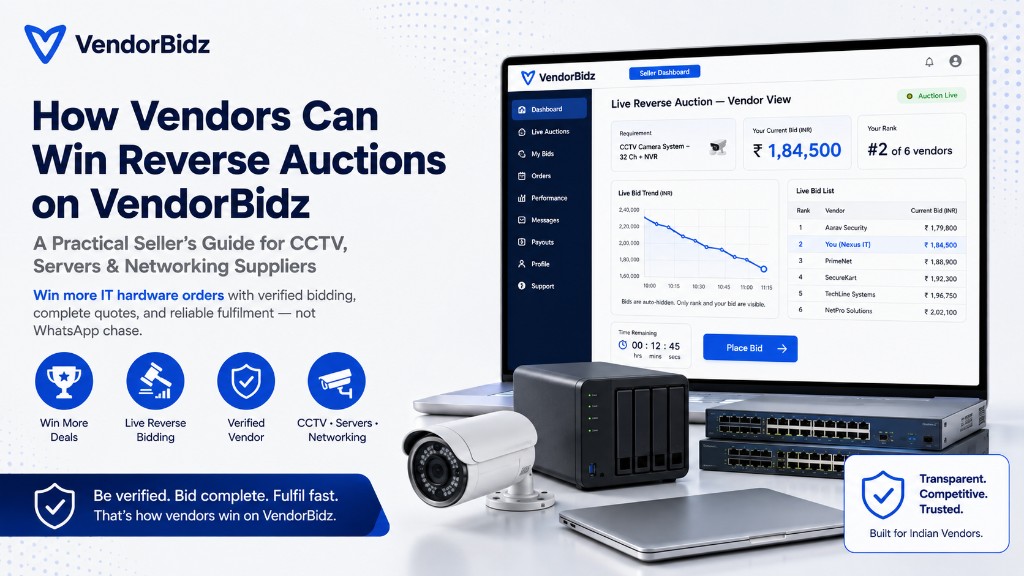
Buying IT hardware for a business should not feel like a guessing game—and selling it should not mean chasing unpaid WhatsApp quotations for days.
Yet many CCTV dealers, server suppliers, and networking distributors in India still follow the same process: wait for a requirement, prepare a quotation, send it on WhatsApp, follow up repeatedly, and eventually discover that the buyer chose another vendor.
The problem is not always the product or the price.
Often, it is the process.
You may not know how many vendors are competing. The buyer may receive different specifications from different suppliers. Requirements can change during the quotation process. And by the time you hear the final price, the opportunity may already be gone.
VendorBidz reverse auctions bring structure to that process.
A buyer posts a defined requirement. Relevant vendors compete for the order. Vendors can submit competitive bids based on the same requirement, while buyers get a clearer way to compare offers.
For vendors selling CCTV systems, enterprise servers, networking equipment, laptops, workstations, and IT peripherals, this creates a more direct route to genuine purchase requirements.
This guide explains how reverse auctions work from the seller’s side and how vendors can compete effectively without sacrificing sustainable margins.
What Is a Reverse Auction for Vendors?
In a traditional auction, buyers compete and the price generally moves upward.
In a reverse auction, sellers compete and the price generally moves downward.
For an IT hardware vendor, the process typically looks like this:
- 1A buyer posts a specific hardware requirement.
- 2Relevant vendors are notified or discover the requirement.
- 3Verified vendors review the specifications.
- 4Vendors submit competitive bids.
- 5The buyer compares the offers.
- 6The selected vendor proceeds through the order and fulfilment process.
For example, a company may need:
- 32 CCTV cameras
- 2 NVRs
- Required storage
- PoE switches
- Cabling
- Installation support
Instead of sending separate quotations and waiting for the buyer to respond, participating vendors compete around the same defined requirement.
The goal is not simply to offer the lowest number.
The goal is to submit a competitive, complete, and deliverable offer.
Why Traditional Vendor Selling Often Becomes Difficult
WhatsApp and direct quotations are still useful for many businesses. However, the traditional process creates several problems when handling repeated or bulk IT hardware requirements.
1. You Don’t Know the Competition
You may spend time preparing a quotation without knowing whether five vendors or twenty vendors are competing.
2. Buyers Receive Different Scopes
One vendor may quote a complete solution while another quotes only the main hardware.
This makes comparison difficult.
3. Follow-Ups Consume Time
A salesperson may spend hours following up with a buyer who has already selected another supplier.
4. Last-Minute Price Negotiation Hurts Margins
Without a structured bidding environment, vendors often discover the buyer’s expected price only after multiple rounds of negotiation.
5. Unclear Buyer Intent
Not every quotation request results in an actual purchase.
A structured procurement requirement gives vendors a better signal that the buyer is actively evaluating suppliers.
How VendorBidz Reverse Auctions Work for Sellers
Step 1: Complete Your Vendor Profile
The first step is to make your vendor profile useful to buyers.
Clearly mention the categories you actually supply, such as:
- CCTV and surveillance
- Servers
- Networking equipment
- Laptops
- Workstations
- Storage
- IT peripherals
Also make sure your service areas and fulfilment capabilities are accurate.
A vendor who can realistically deliver in a particular city has a stronger position than one who claims nationwide capability but cannot fulfil quickly.
Accuracy builds trust.
Step 2: Read the Requirement Before You Bid
Never bid based only on the requirement title.
Read the complete specification.
Check:
- Quantity
- Brand preference
- Model or SKU requirements
- Equivalent-product conditions
- Required performance
- Delivery location
- Delivery deadline
- Warranty requirements
- Installation requirements
- Accessories
- Licences
- Storage requirements
- Networking requirements
For CCTV, for example, the requirement may include more than cameras.
It may also include:
- NVR
- HDD
- PoE switch
- SMPS
- Rack
- Cat6 cable
- Connectors
- Installation
Missing even one of these can make an apparently low quotation incomplete.
Step 3: Calculate Your Real Cost Before Bidding
One of the biggest mistakes vendors make is deciding their price while the auction is already running.
Know your numbers first.
Your calculation should consider:
Product Cost + GST + Logistics + Installation/Support + Warranty Risk + Other Costs + Sustainable Margin = Minimum Acceptable Price
This gives you a clear floor price.
Once the bidding begins, you can compete confidently without making decisions based purely on pressure.
Don’t Confuse Competitive Pricing With Loss-Making
A reverse auction is designed to create price competition.
That does not mean you should accept every price.
Winning an order below your actual cost may give you one purchase order but create a long-term problem.
A healthy vendor strategy is:
Bid competitively, but only at a price you can actually fulfil.
Step 4: Submit a Complete Bid
A low price is not useful if the scope is incomplete.
Suppose the buyer requests:
20 CCTV cameras + NVR + HDD + PoE switch + cabling
and a vendor bids only on the cameras.
The price may look attractive, but the buyer still has to source the remaining equipment.
That is not a genuinely competitive offer.
Your bid should clearly cover the requested scope or explicitly identify any exclusions.
Complete bids make comparison easier and reduce misunderstandings.
Step 5: Compete on More Than Price
Price is important in a reverse auction.
But serious procurement decisions can also depend on:
- Product availability
- Delivery time
- Warranty
- Vendor reliability
- Specification accuracy
- After-sales support
- Installation capability
- Invoice and documentation
Imagine two vendors submit similar prices.
Vendor A — Delivery: 15 days. Warranty unclear. Some accessories excluded.
Vendor B — Delivery: 3–5 days. Clear warranty. Complete scope. Ready stock.
The second vendor may provide greater overall value even if the price difference is small.
That’s why your competitive advantage should not be limited to one number.
How Winning Vendors Approach Reverse Auctions
Know Your Price Floor
Before joining an auction, know exactly how low you can go.
Consider:
- Purchase cost
- GST
- Transportation
- Packaging
- Installation
- Payment-related costs
- Warranty exposure
- Operational expenses
- Minimum acceptable margin
Once you have calculated your floor, bidding becomes a business decision rather than an emotional reaction.
Respond Quickly
Speed matters when buyers are actively comparing vendors.
A vendor who responds quickly with a complete quotation demonstrates readiness.
But speed should not mean careless bidding.
The ideal combination is:
Fast response + Accurate specification + Complete scope + Sustainable price
Don’t Use a Teaser Price
Avoid quoting an artificially low number for one component and then adding essential items later.
For example: “Camera ₹X” when the buyer actually needs a complete CCTV solution.
This can create confusion and damage trust.
Quote the requirement as it was requested.
Make Delivery a Competitive Advantage
If you have ready stock, use it.
If you can deliver faster than competitors, state the realistic timeline clearly.
For example: Ready stock | Dispatch within 48 hours | Delivery as per buyer location
Only make commitments you can actually fulfil.
Make Warranty Clear
Warranty is particularly important for IT hardware.
State:
- Warranty period
- Manufacturer warranty or seller warranty
- Replacement process
- Installation coverage
- Any exclusions
A slightly higher price with clearly defined warranty support can be more valuable than a cheaper offer with unclear after-sales responsibility.
Common Mistakes Vendors Should Avoid
1. Bidding Without Reading Specifications
Wrong camera resolution, incompatible NVR, incorrect storage, or missing networking equipment can make the bid unusable.
2. Lowest-Price Panic
Dropping your price repeatedly just because another vendor is cheaper can destroy your margin.
3. Changing Brands Without Clearly Mentioning It
If the buyer requested a specific brand and you are offering an equivalent, clearly state the alternative.
Never create confusion by silently replacing the requested product.
4. Ignoring Delivery Location
A product may be inexpensive at your warehouse but expensive to deliver to another city.
Always calculate the actual landed cost.
5. Over-Promising Installation
If you only supply hardware, say so.
If you provide installation, specify what is included.
6. Winning and Then Delaying Fulfilment
Winning the auction is only the beginning.
Late dispatch, missing products, or poor communication can affect future opportunities.
Your post-order performance is part of your vendor reputation.
Reverse Auctions vs Traditional WhatsApp Quotations
| Factor | Traditional WhatsApp Quotes | VendorBidz Reverse Auction |
|---|---|---|
| Lead quality | Mixed | Requirement-driven |
| Competition visibility | Usually hidden | Structured bidding environment |
| Requirement comparison | Can vary between quotes | Based on a common requirement |
| Follow-up | Often manual | More structured |
| Price discovery | Negotiation-based | Competitive bidding |
| Closing process | Can become informal | Structured order flow |
| Repeat opportunity | Relationship dependent | Can be based on platform performance |
Traditional quotations remain useful for highly customised projects and long-term account relationships.
For standard and semi-standard IT hardware requirements, however, structured reverse bidding can give vendors a more efficient way to compete.
Which Vendors Can Benefit Most?
VendorBidz can be particularly useful for suppliers operating in categories where multiple vendors can fulfil the same or similar requirement.
CCTV Dealers
Useful for:
- Cameras
- NVRs
- Storage
- PoE equipment
- Accessories
- Complete surveillance packages
Server Suppliers
Useful for:
- Rack servers
- Tower servers
- CPUs
- RAM
- Storage
- Server accessories
Networking Distributors
Useful for:
- Switches
- Routers
- Access points
- Network accessories
- Structured networking equipment
Laptop and Workstation Vendors
Useful for:
- Business laptops
- Desktop systems
- Workstations
- Monitors
- Accessories
IT Peripheral Suppliers
Useful for:
- Storage devices
- Keyboards
- Mice
- Printers
- UPS systems
- Other business IT accessories
If you specialise in one or two categories, start there.
Category expertise is often more valuable than claiming to sell everything.
Practical Examples
Example 1: CCTV Requirement
A business needs a complete surveillance system for a new facility.
The requirement includes:
- 32 cameras
- NVR
- HDD
- PoE switching
- Cabling
- Installation
A strong vendor does not simply quote the cheapest camera.
They calculate the complete solution, confirm stock, provide the correct specifications, state installation terms, and give a realistic delivery timeline.
That creates a more reliable bid.
Example 2: Server and Networking Requirement
An SME needs servers and network switches for a new office.
A strong vendor confirms:
- Exact server configuration
- Processor
- RAM
- Storage
- Warranty
- Switch specifications
- Rack requirements
- Delivery timeline
Instead of submitting an approximate “server package,” the vendor provides a clearly defined solution.
This makes the offer easier for the buyer to evaluate.
Example 3: Office Expansion Requirement
A growing company is opening a new branch.
The requirement includes:
- Laptops
- Monitors
- Networking equipment
- Keyboards and mice
- Basic accessories
A vendor who can provide the complete requirement may have an advantage over a supplier offering only one product category.
The buyer gets a consolidated procurement option, while the vendor gets a larger order opportunity.
Vendor Checklist Before Every Bid
Use this checklist before submitting a reverse-auction bid:
- Vendor profile is verified and up to date
- The requirement has been read completely
- Quantities have been checked
- Product specifications have been verified
- Brand or equivalent conditions are understood
- All required accessories are included
- Delivery location has been considered
- Delivery timeline is realistic
- Warranty terms are clear
- Installation requirements are understood
- GST and logistics costs are included
- Minimum acceptable price has been calculated
- The bid can be fulfilled if accepted
- No unsupported promises have been made
This simple process can prevent both losing bids unnecessarily and winning orders that become difficult to fulfil.
How VendorBidz Helps Vendors
VendorBidz is designed to connect businesses with vendors for structured IT hardware procurement.
For vendors, the platform can provide opportunities to:
- Access high-intent hardware requirements
- Discover buyers looking for CCTV, servers, networking, and IT equipment
- Participate in competitive reverse bidding
- Submit offers against clearly defined requirements
- Compete on price, delivery, and overall value
- Move accepted orders through a structured procurement flow
- Build credibility through reliable fulfilment
The objective is straightforward:
Buyers get access to competition. Vendors get access to genuine demand.
Why Fulfilment Matters After You Win
Winning an auction is not the end of the sales process.
It is the beginning of your relationship with the buyer.
A vendor should focus on:
Accurate Order Confirmation
Confirm the exact products and quantities.
Timely Dispatch
Ship according to the committed timeline.
Proper Documentation
Provide invoices, warranty information, and relevant product documents.
Clear Communication
Keep the buyer informed if anything changes.
After-Sales Support
Handle warranty and support requirements professionally.
A vendor who consistently fulfils orders builds a stronger reputation and creates better opportunities for future business.
The Winning Formula for VendorBidz
There is no single trick that guarantees every reverse auction.
But successful bidding generally comes down to five fundamentals:
1. Be Verified
Maintain a complete and accurate vendor profile.
2. Read the Requirement
Understand exactly what the buyer needs.
3. Price Intelligently
Be competitive without creating an unsustainable deal.
4. Offer Complete Value
Consider delivery, warranty, availability, and support—not only price.
5. Fulfil Reliably
Your performance after the auction matters as much as your bid.
Frequently Asked Questions
What is a reverse auction?
A reverse auction is a procurement process where multiple sellers compete to fulfil a buyer’s requirement, generally through competitive pricing.
Is the lowest bid always the winner?
Not necessarily. Buyers may also consider product specifications, availability, delivery, warranty, support, and overall value.
What should I calculate before bidding?
Calculate your actual landed cost, including product cost, GST, logistics, installation if applicable, warranty exposure, and your minimum acceptable margin.
Can I offer an equivalent brand?
If the buyer allows equivalents, you can offer a suitable alternative. Clearly mention the brand and model so the buyer can compare it properly.
What happens if I win but cannot fulfil the order?
Only bid on requirements you can realistically fulfil. Failing to deliver can damage your business relationship and vendor reputation.
Which IT hardware categories are suitable for reverse auctions?
Common categories include CCTV, servers, networking equipment, laptops, workstations, storage, and IT peripherals.
Final Takeaway
A reverse auction should not be treated as a race to destroy your margin.
For IT hardware vendors, it is a structured way to reach serious buyers, compete against other suppliers, and win orders based on a combination of price, availability, delivery, reliability, and service.
If you sell CCTV systems, enterprise servers, networking equipment, laptops, or IT peripherals, the approach is simple:
- Be verified.
- Read the requirement.
- Bid on the complete scope.
- Know your minimum price.
- Compete on value.
- Fulfil what you win.
The strongest vendors on a procurement platform are not necessarily the ones who submit the cheapest bid every time.
They are the ones buyers can trust to provide the right products, at the right price, within the promised timeline.
Ready to Win More IT Hardware Orders?
Register as a vendor on VendorBidz, complete your verification, and start bidding on live CCTV, server, networking, laptop, and IT hardware requirements.
Register as a Vendor →Contact Us
Have a procurement question or want help posting your first hardware requirement? Reach out to the VendorBidz team.
VendorBidz
Powered by Shweta Technologies
Address
C-35, Tirupati Sahibag, Village Panchot,
Mehsana, Gujarat 384205, India