What Is a Reverse Auction for IT Hardware Procurement? A Complete Buyer’s Guide for Indian Businesses
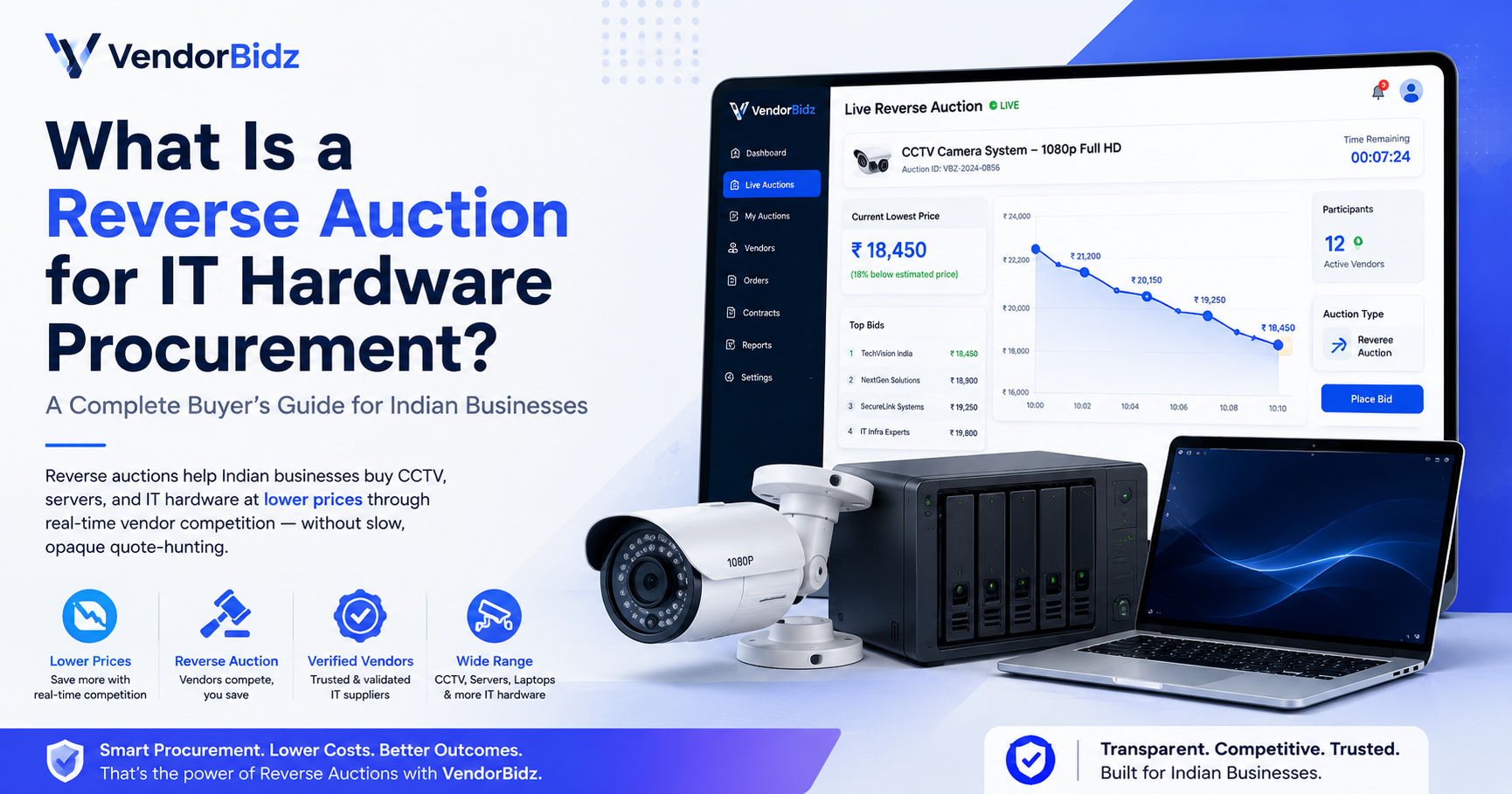
Buying IT hardware for a business should not feel like a guessing game. Yet many companies in India still rely on the same old cycle: call three vendors, wait for quotes, negotiate over WhatsApp, and hope the final price is fair.
For CCTV systems, servers, networking gear, laptops, and peripherals, that process often leads to one problem — you overpay because vendors do not truly compete in real time.
That is exactly where reverse auctions change the game.
If you are a business owner, IT manager, facility head, or procurement buyer looking for a smarter way to source hardware, this guide explains what reverse auctions are, how they work, and why they are becoming one of the most practical ways to buy IT infrastructure in India.
What Is a Reverse Auction?
In a normal auction, buyers compete and prices usually go up.
In a reverse auction, sellers compete and prices usually go down.
Here is the basic idea:
- 1A buyer posts a requirement (for example, 20 CCTV cameras + NVR + installation accessories).
- 2Verified vendors see that request.
- 3Vendors bid against each other in real time.
- 4Each competitive bid can drive the price lower.
- 5The buyer reviews the best offers and places the order.
Instead of chasing suppliers one by one, the market comes to you — and competition works in your favour.
On platforms like VendorBidz, this process is built specifically for IT hardware procurement, so businesses can source CCTV, servers, networking equipment, and peripherals through live reverse bidding rather than slow, opaque quote-hunting.
Why Traditional Hardware Buying Often Fails
Most businesses still buy hardware through manual RFQs. The process looks simple, but it has clear weaknesses:
- Quotes arrive at different times, so comparison is messy.
- Vendors may keep prices high if they sense low competition.
- Follow-ups waste days or weeks.
- Spec sheets are incomplete, so vendors quote apples-to-oranges.
- Buyers cannot always tell if a supplier is reliable.
For small and mid-sized businesses, this creates friction. For growing companies buying repeatedly — offices, warehouses, branches, hospitals, schools, factories — the cost of poor procurement adds up quickly.
A reverse auction reduces that friction by creating a structured, competitive event around one clear requirement.
How Reverse Auction Procurement Works (Step by Step)
1. Post a clear requirement
The buyer defines exactly what is needed. Clear specs matter. For example:
- Camera resolution and brand preference
- Number of channels / NVR capacity
- Cable, PoE switch, hard disk, and accessories
- Delivery location and timeline
- Warranty expectations
The clearer your request, the better the bids.
2. Vendors get matched
Relevant suppliers — especially those specializing in your category — get notified and can join the opportunity.
3. Live reverse bidding begins
Vendors compete by offering better pricing. Because everyone is bidding for the same requirement, the market finds a more realistic floor price.
4. Buyer reviews and selects
Price is important, but not the only factor. A good buyer also checks:
- Vendor reliability
- Delivery timeline
- Warranty support
- Scope clarity
- Total landed value
5. Confirm and order
Once a bid is accepted, the order moves into payment and fulfilment with a defined process — not endless back-and-forth messaging.
This is one of the biggest advantages: reverse auctions replace chaos with a clean procurement workflow.
What Types of IT Hardware Work Best in Reverse Auctions?
Reverse auctions are especially effective when the product is well defined and multiple suppliers can fulfill the same need. Common examples include:
- CCTV and surveillance systems
- Enterprise servers and processors
- Networking switches, routers, and access points
- Laptops and workstations
- IT peripherals such as keyboards, storage, and related accessories
If your purchase is mostly specification-driven — quantity, model range, delivery, and warranty — reverse bidding is often more efficient than asking every vendor for a separate quotation.
Key Benefits for Indian Businesses
Lower prices through real competition
When vendors compete openly, buyers usually unlock better rates than single-vendor negotiation.
Faster decision-making
One requirement. Multiple bids. Clear comparison. That alone can save days of follow-up.
Better transparency
You can see how the market responds instead of accepting the first “best offer” you receive.
Stronger vendor quality when the network is verified
A reverse auction works best when suppliers are screened. Verified vendors reduce the risk of fake quotes, delayed supply, or poor after-sales support.
Scalable for repeat buying
Whether you are setting up one office or provisioning multiple locations across Gujarat or other Indian markets, the same process can be reused.
Common Mistakes Buyers Should Avoid
Even a strong reverse auction can fail if the buyer side is unclear. Avoid these mistakes:
- 1Vague requirements — “Need CCTV cameras” is not enough. Mention quantity, use case, and must-have specs.
- 2Comparing only on lowest price — Ultra-low bids with weak warranty or incomplete scope can cost more later.
- 3Mixing different scopes in one request — Keep related items together, but do not make the request so mixed that vendors cannot quote accurately.
- 4Ignoring delivery and support terms — Price without timeline and support is incomplete.
- 5Choosing an unverified seller network — Competition is useful only when the suppliers are genuine.
Reverse Auctions vs Normal Quotation Buying
| Factor | Traditional Quotes | Reverse Auction |
|---|---|---|
| Competition | Limited | High and real-time |
| Speed | Slow follow-ups | Faster bid cycle |
| Price pressure | Soft negotiation | Market-driven drops |
| Comparison | Often uneven | Structured around one request |
| Transparency | Low | Higher |
Traditional quotations can still work for highly custom or complex projects. But for standard and semi-standard IT hardware buying, reverse auctions usually create stronger pricing discipline.
Who Should Use Reverse Auction Procurement?
This approach is especially useful for:
- SMEs expanding offices or branches
- Enterprises buying hardware in bulk
- Facility teams deploying surveillance systems
- Procurement managers seeking better control over IT spend
- Businesses tired of overpaying for servers, CCTV, and peripherals
If your goal is simple — post once, let vendors compete, and buy smarter — reverse auction procurement is built for you.
How VendorBidz Fits Into This Model
VendorBidz is designed as an autonomous hardware procurement network for businesses that want lower prices without losing process control.
Instead of juggling multiple vendor chats, buyers can:
- Submit a hardware requirement
- Attract verified suppliers
- Run live reverse bidding
- Select a competitive offer
- Complete the transaction through a structured checkout flow
For vendors, the value is equally clear: access to high-intent buyers who are actively ready to purchase CCTV, IT infrastructure, and peripherals.
That two-sided marketplace model is what makes reverse auctions practical — not just theoretical.
Final Takeaway
A reverse auction is not just another bidding gimmick. For IT hardware procurement, it is a practical way to force transparent competition, reduce overpayment, and shorten buying cycles.
If you are sourcing CCTV systems, servers, networking gear, or peripherals in India, the smartest first step is not asking for one more quote. It is putting your requirement in front of multiple verified vendors and letting the market compete.
Ready to stop overpaying for IT hardware?
Post your requirement on VendorBidz and let vendors compete for your business.
Post Requirement →Contact Us
Have a procurement question or want help posting your first hardware requirement? Reach out to the VendorBidz team.
VendorBidz
Powered by Shweta Technologies
Address
C-35, Tirupati Sahibag, Village Panchot,
Mehsana, Gujarat 384205, India